July 26

St. Nicholas Greek Orthodox Church
Publish Date: 2026-07-26
Bulletin Contents

St. Nicholas Greek Orthodox Church
General Information
- Phone:
- (734) 332-8200
- Fax:
- (734) 332-8201
- Email:
- [email protected]
- Street Address:
- 3109 Scio Church Road
- Ann Arbor, MI 48103
Contact Information
Services Schedule
9:00 am Orthros
10:00 am Divine Liturgy
Office closed during all church services.
Past Bulletins
- Publish Date:
- 2026-07-19
- Publish Date:
- 2026-07-12
- Publish Date:
- 2026-07-05
- Publish Date:
- 2026-06-28
- Publish Date:
- 2026-06-21
- Publish Date:
- 2026-06-14
Hymns of the Day
Resurrectional Apolytikion in the Grave Mode
You destroyed death by Your Cross, You opened Paradise to the Robber. You turned the Myrrh-bearing Women’s lament into joy, and You commanded Your Apostles to preach that You rose, O Christ God, granting the world the great mercy.
Κατέλυσας τῷ Σταυρῷ σου τὸν θάνατον, ἠνέῳξας τῷ Λῃστῇ τὸν Παράδεισον, τῶν Μυροφόρων τὸν θρῆνον μετέβαλες, καὶ τοῖς σοῖς Ἀποστόλοις κηρύττειν ἐπέταξας, ὅτι ἀνέστης Χριστὲ ὁ Θεός, παρέχων τῷ κόσμῳ τὸ μέγα ἔλεος.
Apolytikion for Martyr Paraskeve in the First Mode
Showing a diligence befitting thy calling, O namesake of preparedness, thou hast gained, as thy dwelling, a faith worthy of thy name, O prizewinning Paraskeve. Hence, thou pourest forth healings and intercedest for our souls.
Τήν σπουδήν σου τή κλήσει κατάλληλον, εργασαμένη φερώνυμε, τήν ομώνυμόν σου πίστιν εις κατοικίαν κεκλήρωσαι, Παρασκευή αθλοφόρε, όθεν προχέεις ιάματα, καί πρεσβεύεις υπέρ τών ψυχών ημών.
Seasonal Kontakion in the Second Mode
A protection of Christians unshamable, intercessor to our Holy Maker, unwavering, please reject not the prayerful cries of those who are in sin. Instead, come to us, for you are good; your loving help bring unto us, who are crying in faith to you: hasten to intercede and speed now to supplicate, as a protection for all time, Theotokos, for those who honor you.
Προστασία τῶν Χριστιανῶν ἀκαταίσχυντε, μεσιτεία πρὸς τὸν Ποιητὴν ἀμετάθετε. Μὴ παρίδῃς ἁμαρτωλῶν δεήσεων φωνάς, ἀλλὰ πρόφθασον, ὡς ἀγαθή, εἰς τὴν βοήθειαν ἡμῶν, τῶν πιστῶς κραυγαζόντων σοι· Τάχυνον εἰς πρεσβείαν, καὶ σπεῦσον εἰς ἱκεσίαν, ἡ προστατεύουσα ἀεί, Θεοτόκε, τῶν τιμώντων σε.
Gospel and Epistle Readings
Matins Gospel Reading
Eighth Orthros Gospel
The Reading is from John 20:11-18
At that time, Mary stood weeping outside the tomb, and as she wept she stooped to look into the tomb, and she saw two angels in white, sitting where the body of Jesus has lain, one at the head and one at the feet. They said to her, "Woman, why are you weeping?" She said to them, "Because they have taken away my Lord, and I do not know where they have laid Him." Saying this, she turned round and saw Jesus standing, but she did not know that it was Jesus. Jesus said to her, "Woman, why are you weeping? Whom do you seek?" Supposing Him to be the gardener, she said to Him, "Sir, if you have carried Him away, tell me where you have laid Him, and I will take Him away." Jesus said to her, "Mary." She turned and said to Him in Hebrew, "Rabboni," which means Teacher. Jesus said to her, "Do not touch Me, for I have not yet ascended to the Father; but go to My brethren and say to them, I am ascending to My Father and your Father, to My God and your God." Mary Magdalene went and said to the disciples, "I have seen the Lord," and she told them that He had said these things to her.
Eighth Orthros Gospel
Κατὰ Ἰωάννην 20:11-18
Τῷ καιρῷ ἐκείνῳ, Μαρία εἱστήκει πρὸς τὸ μνημεῖον κλαίουσα ἔξω· ὡς οὖν ἔκλαιε, παρέκυψεν εἰς τὸ μνημεῖον, καὶ θεωρεῖ δύο ἀγγέλους ἐν λευκοῖς καθεζομένους, ἕνα πρὸς τῇ κεφαλῇ, καὶ ἕνα πρὸς τοῖς ποσίν, ὅπου ἔκειτο τὸ σῶμα τοῦ Ἰησοῦ, καὶ λέγουσιν αὐτῇ ἐκεῖνοι· Γύναι, τί κλαίεις; λέγει αὐτοῖς· Ὅτι ᾖραν τὸν Κύριόν μου, καὶ οὐκ οἶδα ποῦ ἔθηκαν αὐτόν· καὶ ταῦτα εἰποῦσα ἐστράφη εἰς τὰ ὀπίσω, καὶ θεωρεῖ τὸν Ἰησοῦν ἑστῶτα, καὶ οὐκ ᾒδει ὅτι Ἰησοῦς ἐστι. Λέγει αὐτῇ ὁ Ἰησοῦς· Γύναι, τί κλαίεις; τίνα ζητεῖς; ἐκείνη δοκοῦσα ὅτι ὁ κηπουρὸς ἐστι, λέγει αὐτῷ· Κύριε, εἰ σὺ ἐβάστασας αὐτόν, εἰπέ μοι ποῦ αὐτὸν ἔθηκας, κᾀγὼ αὐτὸν ἀρῶ· λέγει αὐτῇ ὁ Ἰησοῦς· Μαρία· στραφεῖσα ἐκείνη λέγει αὐτῷ· Ῥαββουνί· ὃ λέγεται Διδάσκαλε· λέγει αὐτῇ ὁ Ἰησοῦς, Μή μου ἃπτου· οὔπω γὰρ ἀναβέβηκα πρὸς τὸν πατέρα μου, πορεύου δὲ πρὸς τοὺς ἀδελφούς μου, καὶ εἰπὲ αὐτοῖς· Ἀναβαίνω πρὸς τὸν πατέρα μου καὶ πατέρα ὑμῶν, καὶ Θεόν μου καὶ Θεὸν ὑμῶν· ἔρχεται Μαρία ἡ Μαγδαληνὴ ἀπαγγέλλουσα τοῖς μαθηταῖς ὅτι ἑώρακε τὸν Κύριον· καὶ ταῦτα εἶπεν αὐτῇ.
Epistle Reading
Prokeimenon. Plagal Fourth Mode. Psalm 67.35,26.
God is wonderful among his saints.
Verse: Bless God in the congregations.
The reading is from St. Paul's Letter to the Galatians 3:23-29; 4:1-5.
Brethren, before faith came, we were confined under the law, kept under restraint until faith should be revealed. So that the law was our custodian until Christ came, that we might be justified by faith. But now that faith has come, we are no longer under a custodian; for in Christ Jesus you are all sons of God, through faith. For as many of you as were baptized into Christ have put on Christ. There is neither Jew nor Greek, there is neither slave nor free, there is neither male nor female; for you are all one in Christ Jesus. And if you are Christ's, then you are Abraham's offspring, heirs according to promise. I mean that the heir, as long as he is a child, is no better than a slave, though he is the owner of all the estate; but he is under guardians and trustees until the date set by the father. So with us; when we were children, we were slaves to the elemental spirits of the universe. But when the time had fully come, God sent forth his Son, born of a woman, born under the law, to redeem those who were under the law, so that we might receive adoption as sons.
Προκείμενον. Plagal Fourth Mode. ΨΑΛΜΟΙ 67.35,26.
Θαυμαστὸς ὁ Θεὸς ἐν τοῖς Ἁγίοις αὐτοῦ.
Στίχ. Ἐν Ἐκκλησίαις εὐλογεῖτε τὸν Θεὸν.
τὸ Ἀνάγνωσμα Πρὸς Γαλάτας 3:23-29, 4:1-5.
Ἀδελφοί, πρὸ τοῦ δὲ ἐλθεῖν τὴν πίστιν, ὑπὸ νόμον ἐφρουρούμεθα, συγκεκλεισμένοι εἰς τὴν μέλλουσαν πίστιν ἀποκαλυφθῆναι. Ὥστε ὁ νόμος παιδαγωγὸς ἡμῶν γέγονεν εἰς Χριστόν, ἵνα ἐκ πίστεως δικαιωθῶμεν. Ἐλθούσης δὲ τῆς πίστεως, οὐκέτι ὑπὸ παιδαγωγόν ἐσμεν. Πάντες γὰρ υἱοὶ θεοῦ ἐστε διὰ τῆς πίστεως ἐν Χριστῷ Ἰησοῦ. Ὅσοι γὰρ εἰς Χριστὸν ἐβαπτίσθητε, Χριστὸν ἐνεδύσασθε. Οὐκ ἔνι Ἰουδαῖος οὐδὲ Ἕλλην, οὐκ ἔνι δοῦλος οὐδὲ ἐλεύθερος, οὐκ ἔνι ἄρσεν καὶ θῆλυ· πάντες γὰρ ὑμεῖς εἷς ἐστε ἐν Χριστῷ Ἰησοῦ. Εἰ δὲ ὑμεῖς Χριστοῦ, ἄρα τοῦ Ἀβραὰμ σπέρμα ἐστέ, καὶ κατʼ ἐπαγγελίαν κληρονόμοι. Λέγω δέ, ἐφʼ ὅσον χρόνον ὁ κληρονόμος νήπιός ἐστιν, οὐδὲν διαφέρει δούλου, κύριος πάντων ὤν· ἀλλὰ ὑπὸ ἐπιτρόπους ἐστὶν καὶ οἰκονόμους, ἄχρι τῆς προθεσμίας τοῦ πατρός. Οὕτως καὶ ἡμεῖς, ὅτε ἦμεν νήπιοι, ὑπὸ τὰ στοιχεῖα τοῦ κόσμου ἦμεν δεδουλωμένοι· ὅτε δὲ ἦλθεν τὸ πλήρωμα τοῦ χρόνου, ἐξαπέστειλεν ὁ θεὸς τὸν υἱὸν αὐτοῦ, γενόμενον ἐκ γυναικός, γενόμενον ὑπὸ νόμον, ἵνα τοὺς ὑπὸ νόμον ἐξαγοράσῃ, ἵνα τὴν υἱοθεσίαν ἀπολάβωμεν.
Gospel Reading
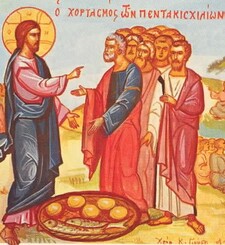
8th Sunday of Matthew
The Reading is from Matthew 14:14-22
At that time, Jesus saw a great throng; and he had compassion on them, and healed their sick. When it was evening, the disciples came to him and said, "This is a lonely place, and the day is now over; send the crowds away to go into the villages and buy food for themselves." Jesus said, "They need not go away; you give them something to eat." They said to him, "We have only five loaves here and two fish." And he said, "Bring them here to me." Then he ordered the crowds to sit down on the grass; and taking the five loaves and the two fish he looked up to heaven, and blessed, and broke and gave the loaves to the crowds. And they all ate and were satisfied. And they took up twelve baskets full of the broken pieces left over. And those who ate were about five thousand men, besides women and children. Then he made the disciples get into the boat and go before him to the other side, while he dismissed the crowds.
8th Sunday of Matthew
Κατὰ Ματθαῖον 14:14-22
Τῷ καιρῷ ἐκείνῳ, ἐξελθὼν ὁ ᾿Ιησοῦς εἶδε πολὺν ὄχλον, καὶ ἐσπλαγχνίσθη ἐπ᾿ αὐτοῖς καὶ ἐθεράπευσε τοὺς ἀρρώστους αὐτῶν. ὀψίας δὲ γενομένης προσῆλθον αὐτῷ οἱ μαθηταὶ αὐτοῦ λέγοντες· ἔρημός ἐστιν ὁ τόπος καὶ ἡ ὥρα ἤδη παρῆλθεν· ἀπόλυσον τοὺς ὄχλους, ἵνα ἀπελθόντες εἰς τὰς κώμας ἀγοράσωσιν ἑαυτοῖς βρώματα. ὁ δὲ ᾿Ιησοῦς εἶπεν αὐτοῖς· οὐ χρείαν ἔχουσιν ἀπελθεῖν· δότε αὐτοῖς ὑμεῖς φαγεῖν. οἱ δὲ λέγουσιν αὐτῷ· οὐκ ἔχομεν ὧδε εἰ μὴ πέντε ἄρτους καὶ δύο ἰχθύας. ὁ δὲ εἶπε· φέρετέ μοι αὐτοὺς ὧδε. καὶ κελεύσας τοὺς ὄχλους ἀνακλιθῆναι ἐπὶ τοὺς χόρτους, λαβὼν τοὺς πέντε ἄρτους καὶ τοὺς δύο ἰχθύας, ἀναβλέψας εἰς τὸν οὐρανὸν εὐλόγησε, καὶ κλάσας ἔδωκε τοῖς μαθηταῖς τοὺς ἄρτους, οἱ δὲ μαθηταὶ τοῖς ὄχλοις. καὶ ἔφαγον πάντες καὶ ἐχορτάσθησαν, καὶ ἦραν τὸ περισσεῦον τῶν κλασμάτων δώδεκα κοφίνους πλήρεις. οἱ δὲ ἐσθίοντες ἦσαν ἄνδρες ὡσεὶ πεντακισχίλιοι χωρὶς γυναικῶν καὶ παιδίων. Καὶ εὐθέως ἠνάγκασεν ὁ Ἰησοῦς τοὺς μαθητὰς αὐτοῦ ἐμβῆναι εἰς τὸ πλοῖον καὶ προάγειν αὐτὸν εἰς τὸ πέραν, ἕως οὗ ἀπολύσῃ τοὺς ὄχλους.
Wisdom of the Fathers
And another thing too we learn, the self-restraint of the disciples which they practised in necessary things, and how little they accounted of food.
Homily 49 on Matthew 14, 4th Century
For being twelve, they had five loaves only and two fishes; so secondary to them were the things of the body: so did they cling to the things spiritual only. And not even that little did they hold fast, but gave up even it when asked.
Homily 49 on Matthew 14, 4th Century
Saints and Feasts


July 26
The Holy Hieromartyrs Hermolaus, Hermippus, and Hermocrates
Saint Hermolaus and those with him were priests of the Church in Nicomedia, living in hiding after the Emperor Maximian had burnt to death the 20,000 Martyrs of Nicomedia (see Dec. 28). It was Hermolaus who converted Saint Panteleimon to Christ. When Saint Panteleimon was seized as a Christian and was asked by Maximian who it was that had turned him from the idols, the Saint, enlightened by God that the time of his teacher's martyrdom also was at hand, revealed to Maximian that it was Hermolaus the priest. Saint Hermolaus was taken with Saints Hermippus and Hermocrates, and when they had confessed Christ to be the only true God, they were beheaded in the year 305. Saint Hermolaus is one of the Holy Unmercenaries.

July 26
Paraskeve the Righteous Martyr of Rome
Saint Paraskeve, who was from a certain village near Rome, was born to pious parents, Agatho and Politia. Since she was born on a Friday (in Greek, Paraskeve), she was given this name, which means "preparation" or "preparedness" (compare Matt. 27:62, Mark 15:42, Luke 23:54, and John 19:31, where 'Friday' is called "the day of the preparation"). From childhood she was instructed in the sacred letters and devoted herself to the study of the divine Scriptures, while leading a monastic life and guiding many to the Faith of Christ. During the reign of the Emperor Antoninus Pius, she was apprehended because she was a Christian and was urged to worship the idols, but she answered with the words of Jeremias: "Let the gods that have not made heaven and the earth perish from off the earth" (Jer. 10:11). Because of this she endured exceedingly painful torments, and was beheaded in the year 140. The faithful pray to her for the healing of eye ailments.

July 26
Prisca the Righteous Martyr

July 26
Moses the Hungarian

July 26
Jacob Netsvetov the Enlightener of Alaska

July 27
Panteleimon the Great Martyr & Healer
This Saint, who had Nicomedia as his homeland, was the son of Eustorgius and Eubula. His father was an idolater, but his mother was a Christian from her ancestors. It was through her that he was instructed in piety, and still later, he was catechized in the Faith of Christ by Saint Hermolaus (see July 26) and baptized by him. Being proficient in the physician's vocation, he practiced it in a philanthropic manner, healing every illness more by the grace of Christ than by medicines. Thus, although his parents had named him Pantoleon ("in all things a lion"), because of the compassion he showed for the souls and bodies of all, he was worthily renamed Panteleimon, meaning "all-merciful." On one occasion, when he restored the sight of a certain blind man by calling on the Divine Name, he enlightened also the eyes of this man's soul to the knowledge of the truth. This also became the cause for the martyrdom of him who had been blind, since when he was asked by whom and in what manner his eyes had been opened, in imitation of that blind man of the Gospel he confessed with boldness both who the physician was and the manner of his healing. For this he was put to death immediately. Panteleimon was arrested also, and having endured many wounds, he was finally beheaded in the year 305, during the reign of Maximian. Saint Panteleimon is one of the Holy Unmercenaries, and is held in special honor among them, even as Saint George is among the Martyrs.

July 28
Irene the Righteous of Chrysovalantou
Saint Irene, who was from Cappadocia, flourished in the ninth century. Because of her great beauty and virtue, she was brought to Constantinople as a prospective bride for the young Emperor Michael (842-867); however, as Saint Joannicius the Great foretold, it was God's will that she assume the monastic habit instead. She shone forth in great ascetical labours, and suffered many attacks from the demons; while yet a novice, she attained to the practice of Saint Arsenius the Great, of praying the whole night long with arms stretched out towards Heaven (see May 8). God showed forth great signs and wonders in her, and she became the Abbess of the Convent of Chrysovalantou. She was granted the gift of clairvoyance and knew the thoughts of all that came to her. She appeared in a vision to the king and rebuked him for unjustly imprisoning a nobleman who had been falsely accused. Through a sailor from Patmos to whom he had appeared, Saint John the Evangelist sent her fragrant and wondrous apples from Paradise. She reposed at the age of 103, still retaining the youthful beauty of her countenance. After her repose, marvelous healings beyond number have been wrought by her to the present day.