Memorial:3 years for Dr. George Meltsakos. May his memory be eternal.
Fellowship Hour hosted by the Meltsakos family in memory of Dr. George Meltsakos.
Parish Council members on duty: Betty Themeles, Penelope Hamourgas and George Tgibides.
Celebrating the gifts & stewardship of the church musicians of our parish – our clergy, the choir and our chanters.Their contributions enhance our worship and assure that the treasury of our hymnography continues to edify us and future generations.
Weekly Calendar
October 16, Thursday:Orthodoxy 101 at the Transfiguration Church
God bless you and the beginning of a new and promising week.
"Whatever you do, work at it with all your heart, as working for the Lord, not for human masters." — Colossians 3:23
October 28, Wednesday: Holy Protection of the Theotokos - OXI Day
November 09, Monday:Nektarios the Wonderworker
November 21, Saturday: Entrance of the Theotokos into the Temple
November 25, Wednesday:Saint Katherine the Great
December 04, Friday: St. Barbara the Martyr
December 15, Tuesday:St. Eleutherios the Holy Martyr
ORTHODOXY 101:The Lowell Council of Orthodox Churches invites you to enrich your faith with Orthodoxy 101. Whether you are seeking Orthodoxy, recently joined, or have been Orthodox since infancy, this 12-week class, taught by the clergy from all four Churches, is sure to deepen your knowledge of the One, Holy, Catholic, and Apostolic Church. Orthodoxy 101 will begin on Thursday, October 1st and will meet in-person every Thursday evening from 6:30-7:30 PM with a Zoom option. Light refreshments will be served. In-person locations will begin in Lowell at the Transfiguration and then will periodically be hosted by the Assumption-St. George in Dracut, Holy Trinity in Lowell, and St. George Antiochian in Lowell. Please register by using the link Orthodoxy 101
Sunday School News:
Registration remains open! Our curriculum will follow the Greek Orthodox Archdiocese of America's Sunday School resources, available at https://www.goarch.org/sundayschool. To register your child, please see Panayiota or Cassandra.Children should arrive at church by 10:30 AM and proceed to the first few rows on the left side of the church. After receiving Holy Communion, the children will go downstairs with their teachers for their Sunday School lesson. They will be dismissed following class. To register your children please click on this link: Sunday School Registration
Philoptochos News: follow us on Facebook at Holy-Trinity-Ladies-Philoptochos-Lowell
Monthly Meetings Calendar
WED 11/04 at 6:00pm
WED 12/02 at 5:30pm
WED 02/03 at 5:30pm
WED 03/03 at 5:30pm
WED 04/07 at 6:00pm
WED 05/05 at 6:00pm
WED 06/02 at 6:00pm
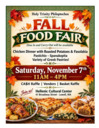
Greek Food Fair and more! -Saturday, November 7, 2026: Every year, the first Saturday of November is reserved for Philoptochos’ main fund-raising event.We invite everyone to stop by and enjoy delicious Greek Food & Pastry, try you luck at the Basket Raffle & Main Ca$h Raffle and more. All proceeds will benefit the philanthropic efforts of the Holy Trinity Philoptochos.
Chair Yoga in the Church Hall, Wednesdays 11am-12pm
Join Us This Fall!Come enjoy fellowship, friendship and a wonderful opportunity to gather together each week. We invite everyone to join us for our fall program!
Fall Dates:October 7, 14, 21 & 28and November 4, 11, 18 & 25
Monthly Fee: $40 (non-refundable), payable by cash or check made out to Holy Trinity Philoptochos. The monthly fee is due on October 7 and November 4.To register or for more information, please contact Donna Zouzas at 508-423-6270 or [email protected].
Annual Hunger & Homeless Food Drive (Oct 4-Nov 22) A collection bin is located in the Narthex.
Suggested donations:
Peanut Butter
Canned Soups, Beans, Vegetables, Fruits & Tuna
Macaroni & Cheese
Snacks
Cereal & Oatmeal
Juice Boxes, Bottled Juice
Pasta & Rice
Baby Food, Diapers
Personal Care Items
Supermarket Gift Cards
Hellenic American Academy and HAA PTA News(hellenicaa.org)
10/14: Boot Mills tour & workshop (Grades 4-5)
10/28: OXI Day Celebration
11/09: Veterans Day Programat 1:00pm The Hellenic American Academy invites veterans from our school and church community to attend our Veterans Day Program at the Hellenic Cultural Center.This special program is an opportunity to recognize and honor those who have served our country and to express our gratitude for their service and sacrifice.We encourage our veterans & their families to join us as we honor those who have served.
Church Office Hours:(978) 458-8092 / [email protected]) Tu–Wed-Th 10am-2pm: If you need to visit the office at a different date or time, please call during office hours or send an email to [email protected], to schedule an appointment. Kindly use the Lewis Street side entrance and ring the bell or, call the office to enter through the elevator entrance.
Pastoral Visits:Please call the Church Office at 978 458-8092 to arrange a hospital, nursing home or shut-in visit by Fr. Nick. Health care facilities are unable to contact us because of HIPAA regulations.Greek Orthodox Archdiocese News & On-Line Ministries www.goarch.org:
Sunday of the 7th Ecumenical Council
The Reading is from St. Paul's Letter to Titus 3:8-15
Titus, my son, the saying is sure. I desire you to insist on these things, so that those who have believed in God may be careful to apply themselves to good deeds; these are excellent and profitable to men. But avoid stupid controversies, genealogies, dissensions, and quarrels over the law, for they are unprofitable and futile. As for a man who is factious, after admonishing him once or twice, have nothing more to do with him, knowing that such a person is perverted and sinful; he is self-condemned.
When I send Artemas or Tychicos to you, do your best to come to me at Nicopolis, for I have decided to spend the winter there. Do your best to speed Zenas the lawyer and Apollos on their way; see that they lack nothing. And let our people learn to apply themselves to good deeds, so as to help cases of urgent need, and not to be unfruitful.
All who are with me send greeting to you. Greet those who love us in the faith. Grace be with you all. Amen.
Sunday of the 7th Ecumenical Council
Πρὸς Τίτον 3:8-15
Sunday of the 7th Ecumenical Council
The Reading is from Luke 8:5-15
The Lord said this parable: "A sower went out to sow his seed; and as he sowed, some fell along the path, and was trodden under foot, and the birds of the air devoured it. And some fell on the rock; and as it grew up, it withered away, because it had no moisture. And some fell among thorns; and the thorns grew with it and choked it. And some fell into good soil and grew, and yielded a hundredfold." And when his disciples asked him what this parable meant, he said, "To you it has been given to know the secrets of the kingdom of God; but for others they are in parables, so that seeing they may not see, and hearing they may not understand. Now the parable is this: The seed is the word of God. The ones along the path are those who have heard; then the devil comes and takes away the word from their hearts, that they may not believe and be saved. And the ones on the rock are those who, when they hear the word, receive it with joy; but these have no root, they believe for a while and in time of temptation fall away. And as for what fell among the thorns, they are those who hear, but as they go on their way they are choked by the cares and riches and pleasures of life, and their fruit does not mature. And as for that in the good soil, they are those who, hearing the word, hold it fast in an honest and good heart, and bring forth fruit with patience." As he said these things, he cried out "He who has ears to hear, let him hear."
Sunday of the 7th Ecumenical Council
Κατὰ Λουκᾶν 8:5-15
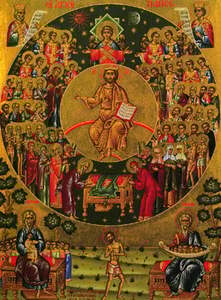
On the Sunday that falls on or immediately after the eleventh of this month, we chant the Service to the 350 holy Fathers of the Seventh Ecumenical Council, which gathered in Nicaea in 787 under the holy Patriarch Tarasius and during the reign of the Empress Irene and her son, Constantine Porphyrogenitus, to refute the Iconoclast heresy, which had received imperial support beginning with the Edict issued in 726 by Emperor Leo the Isaurian. Many of the holy Fathers who condemned Iconoclasm at this holy Council later died as Confessors and Martyrs for the holy Icons during the second assult of Iconoclasm in the ninth century, especially during the reigns of Leo the Armenian and Theophilus.
October 11
Philip the Apostle of the 70, one of the 7 Deacons
Saint Philip, who had four daughters that prophesied, was from Caesarea of Palestine. He preached throughout Samaria; it was he also who met the eunuch of Candace, the Queen of the Ethiopians, as the eunuch was reading the Prophet Esaias, and he instructed and baptized him (Acts 8:26-39). He reposed in Tralles of Asia Minor while preaching the Gospel.
Diakonia Newsletter
Read the latest Diakonia Newsletter for this Sunday
Alpha Omega Council turns 50, with a nod to Isocrates
10/06/2026
BOSTON — “You stole a little bit of my thunder,” Alpha Omega Council President Costa Speliakos said into the microphone, addressing Archbishop Elpidophoros of America, who had just spoken. Onstage before 500 guests in the Fairmont Copley Plaza’s Grand Ballroom for the Council’s 50th anniversary gala Oct. 2, Speliakos nodded: “We are all on the same wavelength.”
Speliakos was referring to an idea the Archbishop had drawn from Isocrates after offering the invocation: that Greek identity rests on shared education and culture, not ancestry alone. “The Greeks are the seedbed of Western civilization,” the Archbishop said, emphasizing that the Hellenic inheritance could be shared by anyone who embraced its ideals. In that spirit, Alpha Omega “welcomes one and all,” he said, citing a condensed version of Isocrates’ words inscribed on the Gennadius Library in Athens: “Those who partake of our culture are called ‘Greeks.’”
Archbishop Elpidophoros of America addresses guests at the Alpha Omega Council’s 50th anniversary gala. Drawing on Isocrates, he emphasized that Greek identity rests on shared education and culture, not ancestry alone. (Orthodox Observer/Areti Bratsis)
The black-tie gala opened a three-day anniversary weekend. Co-chairman Bill Galatis welcomed guests, and Dr. Vivian Paraskevi Douglas and Peter Costarakis performed the national anthems of Greece and the United States. The master of ceremonies was John Metaxas, who joined CNN in 1994 and anchored several of its financial news programs, including “Your Money.”
Peter Agris, publisher of The Hellenic Chronicle, founded the Council in 1976 to bring Greek American professionals together for fellowship and good works. Its 10 incorporators, the Council’s anniversary film recalls, were sons of the boys who came over in the early 1900s: doctors, judges, scientists and government officials at the height of their careers. “There was an auspicious beginning to this wonderful endeavor, and the Omega point is not even yet on the horizon,” Archbishop Elpidophoros said.
“Fifty years ago, a handful of visionaries had an idea, and tonight that idea fills this room,” said Harry J. Vlachos, whose term as the Council’s 38th president ended two days before the gala. Today the Council hosts Greek Heritage Night with the Boston Red Sox, a golf classic and a student essay contest on the Battle of Marathon, and helps crown Boston Marathon winners.
The custom dates to the early 1930s, when George C. Demeter, a Greek American state legislator, took it upon himself to meet the winners at the finish line with laurel wreaths from Greece. Agris, then-Gov. Michael Dukakis and others made it official in 1984. Since then, Greece’s consulate in Boston and the Council have supplied olive wreaths cut in Marathon, Greece, for the men’s and women’s champions in the running and wheelchair divisions.
Metropolitan Methodios of Boston thanked individual Alpha Omega members for their generous contributions to the St. Methodios Faith and Heritage Center in New Hampshire, including its chapel, cafeteria, soccer field and new indoor sports facilities.
The Founders’ Award went to Nancy Agris Savage, the founder’s daughter. A former senior House Foreign Affairs Committee aide, she succeeded her father at The Hellenic Chronicle. The paper was “like the sibling that got all the attention,” she said. Her father met her mother, a disc jockey, while buying an ad on a small Greek radio show in New Hampshire. Each of us, she said, is “a living museum of the immigrants who came here for a better life.” She is now leading the newspaper’s digitization project, which received early support from the Alpha Omega council.
Boston University received the Philhellene Award, which honors champions of Hellenism, Greek or not. Kelly Polychroniou, head of BU’s Modern Greek language program, accepted it for President Melissa L. Gilliam, who could not attend. She noted that in 1877, Boston University awarded Helen Magill White a Ph.D. in Greek, making her the first woman to earn a Ph.D. from an American university. BU is now working with the University of Athens on semester and yearlong study there, she said.
Telemachus “T.A.” Demoulas, a fourth-generation member of Market Basket’s founding family, received the Emerging Leader Award. His great-grandfather Athanasios, he said, landed in New York on St. Patrick’s Day and took the celebrations for a welcome meant for the Greeks. They honored the patron saint of the Irish. Athanasios went back to Greece in 1912 for the First Balkan War, then returned and settled in Lowell, Massachusetts. In 1917 he and his wife, Efrosini, both from Kalambaka, Greece, opened Demoulas Market, a small grocery specializing in lamb. It stood in the Acre, a neighborhood first settled by Irish canal workers and later known as Lowell’s Greektown.
The store made it through the Great Depression largely on credit. Demoulas said his great-grandfather credited the immigrant neighbors who came in every day, the French, the Irish and the Greeks, with keeping it open. The Irish, it turned out, had welcomed him after all. His grandfather and namesake, Telemachus, left high school as a sophomore to help save the store from foreclosure. It grew into Market Basket, one of New England’s largest grocery chains.
Recipients of the Peter Agris Memorial Awards pose with awards organizer Nancy Agris Savage at the Alpha Omega Council’s 50th anniversary gala in Boston. From left to right: Theodora Tsevas, Fotini Anastopoulos, Tyler Davis, Nancy Agris Savage, Maria Manousakis, Christian Andriolas and Calista Sybrant. (Orthodox Observer/Areti Bratsis)
The Peter Agris Memorial Awards, which Agris Savage has run for more than 30 years, have given nearly $1 million to students. This year’s recipients are Fotini Anastopoulos, Christian Andriolas, Tyler Davis, Maria Manousakis, Calista Sybrant and Theodora Tsevas. “I think that at a time when our democracy is in peril and the concept of truth is under attack, your young journalists here give me hope that things can be better for the future,” Metaxas said, wishing them “the courage to pursue the truth.”
Greek singer Konstantinos Argiros was also honored. The next night, he drew an impressive crowd to BU’s Agganis Arena for his Boston concert debut.
Speliakos promised a more visible Council that reaches beyond its own events. He called for closer work with educators, universities and cultural institutions, and a greater role for younger leaders. “Our heritage is extraordinary, but heritage survives only when it is shared,” he said.
BOSTON — “You stole a little bit of my thunder,” Alpha Omega Council President Costa Speliakos said into the microphone, addressing Archbishop Elpidophoros of America, who had just spoken. Onstage before 500 guests in the […]
Ecumenical Patriarch: Freedom is more than ‘doing whatever you want’
10/05/2026
As he received an honorary doctorate at the University of Chichester on September 16, 2026, His All-Holiness Ecumenical Patriarch Bartholomew offered the new graduates of the university, and the world at large, a series of powerful and deeply compelling reflections upon the true nature of freedom and the principles that should guide one’s choices in life.
Speaking to the graduates movingly about his own youth, His All-Holiness stated: “We too, my own generation, were once young, and we lived through the contradictions of our society, its challenges, but also its positive prospects, its disappointments and its hopes.”
His All-Holiness explained that “youth is a period of intense inner crisis for the human person, and the soul of the young person is a sensitive seismograph of developments. The crisis of youth, which is ‘normal’ from an anthropological perspective, is intensified by the external circumstances of each age. Today especially, you young men and women face unprecedented developments in the field of scientific knowledge, momentous changes in the course of history, and continuous ‘digital leaps.’”
His All-Holiness said that like himself and the young people of his age, “you too, the promising young men and women of today, are called to build your present and your future within a civilization which you did not yourselves create.” He admonished the graduates, and all young people, not to neglect the most important questions regarding the meaning of life itself. “Amid the turmoil of human affairs,” he said, “no human being—and certainly not you, young men and women—can push away the ultimate questions about the meaning of existence, about life and death, about happiness and misery, about right and wrong, about good and evil, about the perplexities of our freedom.”
Reminding the graduates that “the human being is not merely a biological entity, nor merely a citizen of the world,” His All-Holiness stated that the human being “is a spiritual being with an exalted vocation. The underestimation or rejection of spiritual values and traditions has gravely negative consequences for every dimension of personal and social life.” He observed that “the fascination with technological achievements leads to the identification of development with technological progress,” and noted also that “the growth of scientific knowledge does not keep pace with the development of the moral sensibilities of the human person.”
This, His All-Holiness, explained, demonstrated the need for religion. “Religion,” he said, “remains of critical importance for contemporary man” because in an age in which the ‘existential vacuum’ is a global phenomenon, amid the pervasive anthropological confusion and the mutually contradictory proposals for the meaning of life, religion is the answer to the ultimate questions of human existence, which stir our minds and souls.” He pointed out that “we cannot imagine a human being who does not ask about the meaning of his life. Religion constitutes ‘a constant of human existence,’ while the suppression of the religious need and its expression provokes profound alienations in the human person.”
The Ecumenical Patriarch also said that “religion is of central importance not only for the personal orientation of life, but also for the identity of peoples and cultures. This became particularly evident at the end of the twentieth century when, after the fall of the Eastern Bloc, the religious self-awareness of its peoples, repressed for decades, re-emerged. Atheist ideology and prohibitions failed to uproot a religious identity bound up directly with the cultural distinctiveness of those peoples. A wholly secularised society, cut off from its religious roots, cannot possibly preserve its humanistic orientation.”
His All-Holiness also pointed out another neglected and often overlooked fact that demonstrates the importance of religion: “Within religious traditions, the greatest achievements of civilization and of particular cultures, their fundamental values, and their ordering of those values were born, shaped, and preserved. With the religions is bound up the great spiritual heritage of humanity. Nothing of significance in the course of human history can be understood without regard to its religious roots. Whatever is most precious among the things that peoples have preserved is connected with their religion or religions. Religious treasures and artefacts fill museums; the religiosity of peoples reveals central aspects of their culture.”
Another “essential function of religion,” His All-Holiness stated, “is its peacemaking power and mission. From Professor Hans Küng comes the phrase: ‘No peace among the nations without peace among the religions. No world peace without peace among the religions. No peace among the religions without dialogue among the religions.’”
“No one can deny,” said the Ecumenical Patriarch, “that today we are living through a profound ‘crisis of freedom.’” He observed that “individual and collective life has become, for the human being, more demanding and more difficult.” Amid these difficulties, “the central question of human existence is the understanding and use of our freedom. Unfortunately, it is proclaimed today with a loud voice that freedom is ‘the art of avoiding commitment.’ The impression has been skillfully planted in our young people that commitment means adaptation to outdated patterns of life, confinement within obsolete schemes. Freedom is very widely identified with the possibility of choice. Yet the truth of our freedom is judged not by the fact that we choose, but by what we choose. The issue that remains is the linking of freedom with responsibility. Freedom understood as responsibility is Ariadne’s thread, which leads us out of our intricate existential labyrinths.”
In line with this understanding of freedom, His All-Holiness told the graduates: “Studying the concept of freedom as autonomy, in the Kantian sense, I came to understand that autonomous freedom does not mean doing whatever I desire; it is not to be identified with a self-sufficient and arrogant self-determination, but is obedience to the moral law, which is the foundation of human dignity, that is, of the absolute worth of the human person. As Kant makes clear, what befits the human being is not the attitude of the arrogant volunteer, who has no need of the idea of duty in order to do good since he does it of his own inclination and initiative, but the attitude of indebtedness and obligation.”
The insight of this philosopher coincided with those of Saint Paul: “We recall here the great theologian of freedom, the Apostle Paul, according to whom the renewal of the human being in Christ is, and is experienced as, liberation and freedom. Freedom, which is a gift from above and not a human achievement, is expressed as the indissoluble unity of faith in God and love for one’s fellow human being, one’s brother.”
His All-Holiness explained that “these two aspects of freedom, the philosophical and the Christian, with their differences but also with their common character as a refusal of the self-deification of the human being and as absolute commitment, together form a robust existential possibility for the creative combination of the identity of the contemporary responsible and free human being with the quality of the believer.” Accordingly, His All-Holiness concluded: “The human being ‘honored with freedom’ has a higher destiny than simply to do ‘whatever he wants.’”
May we all prove worthy of this immense responsibility and honor.
As he received an honorary doctorate at the University of Chichester on September 16, 2026, His All-Holiness Ecumenical Patriarch Bartholomew offered the new graduates of the university, and the world at large, a series of […]